The AI Creative Machine: How I Turned a Creative Funnel Into a System That Runs Itself

Creative is the biggest lever in performance marketing. Everyone agrees on that. What nobody talks about is how much of a creative strategist’s week has nothing to do with creative at all.
Mine looked like this: competitor ads spread across ten tabs, every variation turning into a ticket, a brief and a wait, test results read through a different window and a different lens each week, and, worst of all, good ads found and then never scaled or iterated in time.
So I stopped trying to work faster and built a machine instead.
The short version: one loop, run every week. AI does the searching, writing, editing and reading. I approve plans and spend. The machine runs. I steer.
The results, up front
Before the how, here’s what changed:
- Days → same day. A concept that used to take days to turn into a launch-ready ad set now ships the same day.
- 10x+ creatives tested. We test an order of magnitude more creatives every week, across four formats.
- 3x+ winners. We find three times or more winners, and they get scaled and iterated in days, not weeks.
- Production → strategy. Most of the manual production work is now automated, so my week moved from making ads to deciding which ads should exist.
And the system behind it, by the numbers:
| 20+ | skills: written AI playbooks, one per job |
| 14 | connected tools driven by those skills |
| 1 | concept in, a full ad kit out (avatars, kinetic, films, images) |
| 9 | steps in the Monday run, each with its own skill |
| 4 | weekly action lists for every live creative |
| 1000+ | creators I’ve worked with, now with AI-written briefs |
One loop, run every week
The whole system is a single loop with five stages:
- Research: what is working right now, for competitors and in organic content.
- Produce: turning ideas and references into finished ads.
- Test: getting those ads in front of real audiences.
- Read: working out what actually won and why.
- Scale or iterate: pushing winners harder and making variations of them.
Every Monday the loop starts again from what last week’s tests taught me. That’s the key idea: the system doesn’t just produce ads, it learns from its own results every single week.
All of it lives in one dashboard I built, with a tab for each part of the job: tasks, performance, creative testing, a research and production studio, an ad kit generator, creator campaigns and influencer outreach.
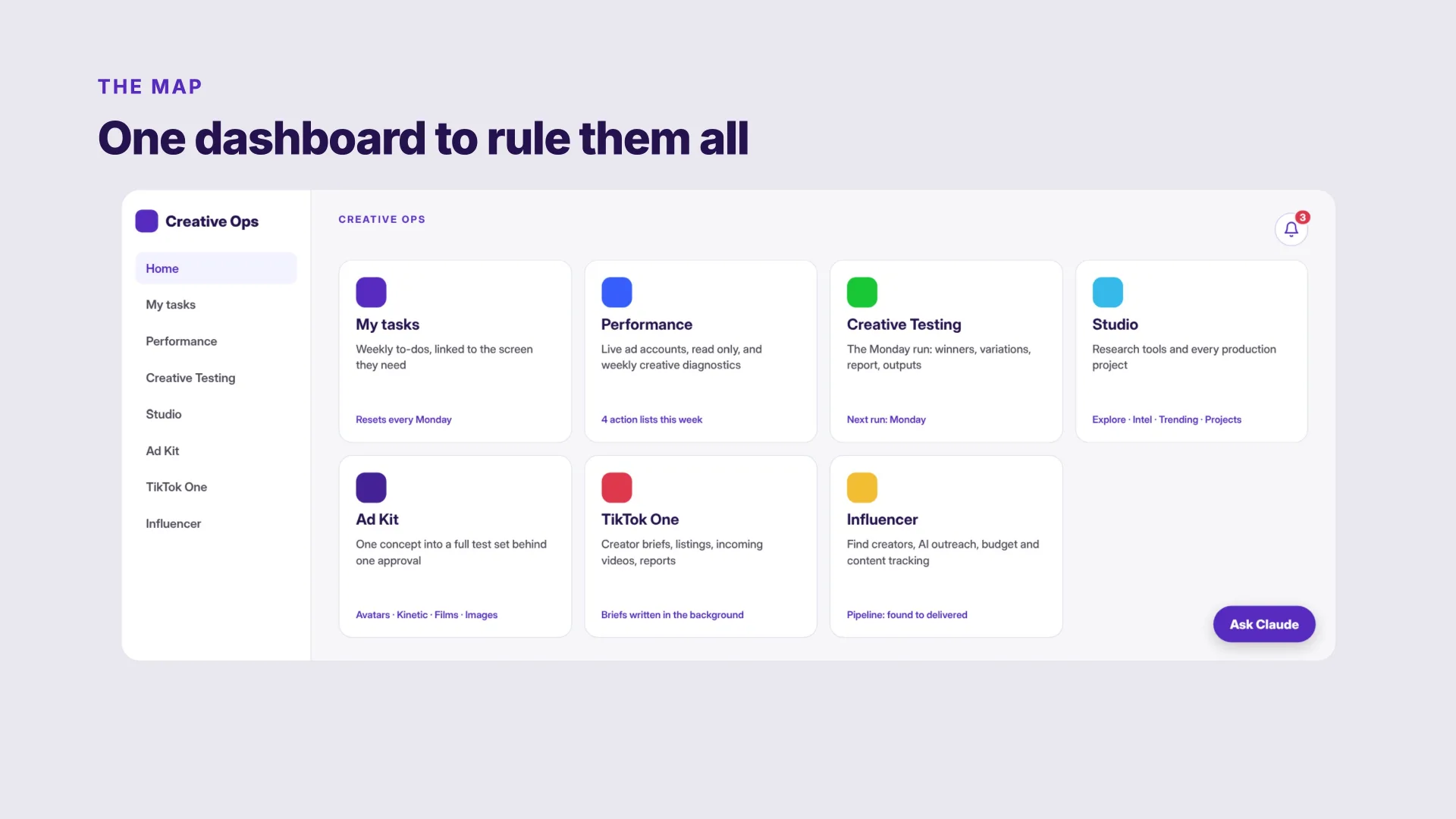
Every tab runs on its own skills
The secret isn’t “using AI”. Anyone can open a chat window. The difference is skills: written playbooks the AI follows, one per job. I built each one over months and trained it on my own test results plus outside references, so the AI works the way I work.
There’s a skill for breaking down why a competitor’s video ad works. One for writing hooks. One for turning a winning image into fifteen variations. One for reading a test campaign and ranking winners. One for writing creator briefs. And a brand skill that checks every claim against a single fact sheet, so no ad ever goes out with a wrong price or an off-brand logo.
These skills drive the tools I already used: AI video and avatar platforms, the ad platforms’ own reporting, competitor intelligence, a launch layer for naming, sizing and uploading, and a local render stack for captions and edits.
Research that never starts from a blank page
Research used to be the most scattered part of the job. Now ads, trends and organic hits are collected for me:
- Explore: trends, search and live ad libraries in one place.
- Competitor intel: competitor videos pulled automatically, with the widest-reaching ads checked every morning.
- Image ads: last week’s competitor image ads, pulled and analysed automatically.
- Trending: organic posts ranked by how fast they’re growing.
A brief now starts from what already works, not from a guess.
From a link to a finished ad
The studio turns any reference into a brand ad. I paste a link to an ad I like; it comes back rebuilt for the brand, with the right design system and end card. Every edit request is versioned (Original, Edit 1, Edit 2), so nothing gets lost, and paid AI credits are only used when I explicitly allow it, up to a cap.
One prompt in, a complete ad set out
This is the part that changed my week the most. I type one concept. The Ad Kit comes back as a launch-ready test set behind a single approval:
- Avatar clips: AI presenters, each script with its own hook, edited with captions and app proof.
- Kinetic ads: animated typography with real app screens, rendered locally at no credit cost.
- Story films: short, mid and long narrative films with dialogue, captions and the end card.
- Static images: image ads in several layouts, each checked for on-image text errors.
Every piece gets a different hook mechanic, so one test teaches me more. Every claim is checked against the brand’s fact sheet, and a final quality check runs before the kit is marked done.
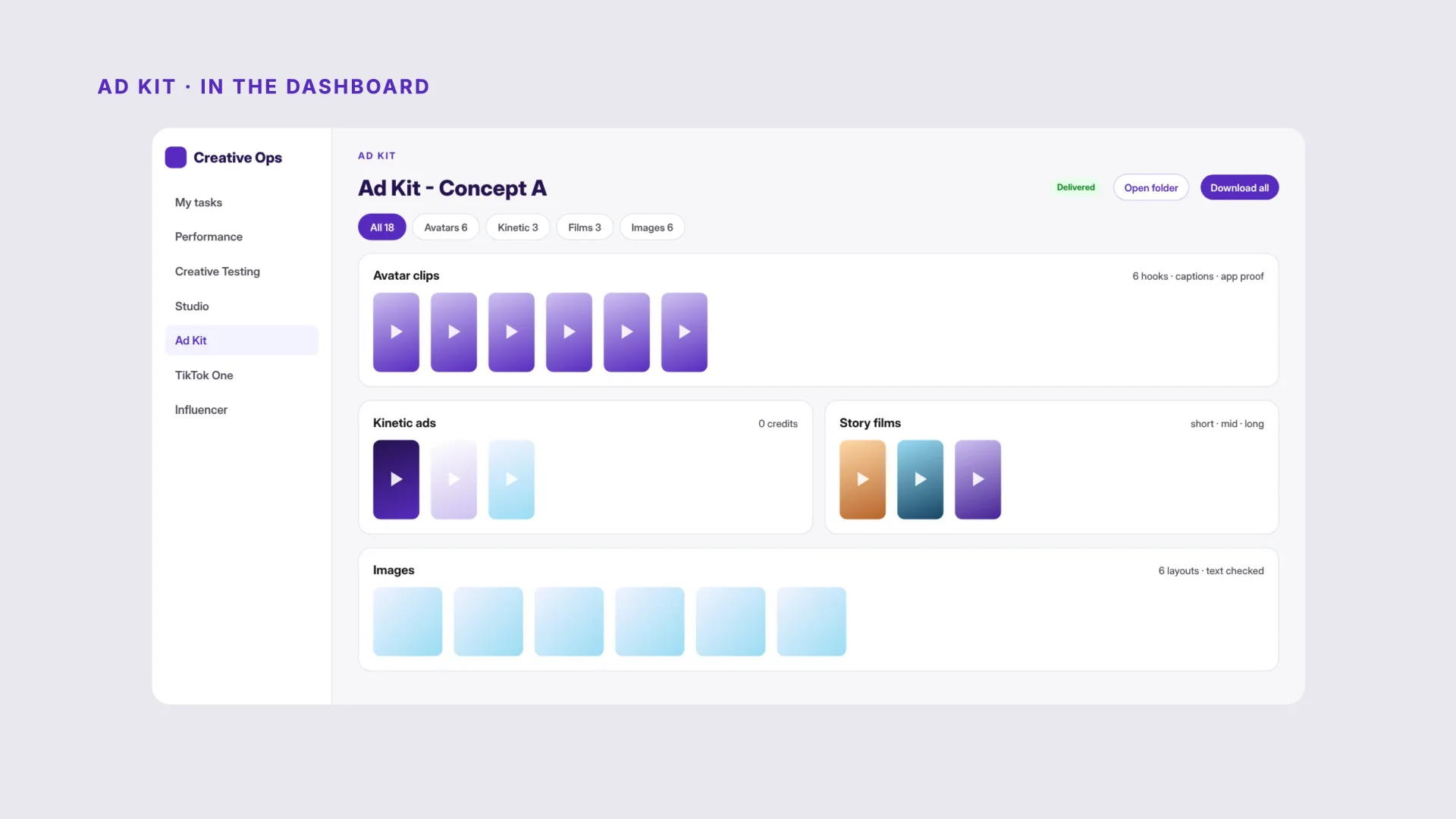
What used to take days of briefs, edits and back-and-forth now ships the same day.
The Monday run: last week’s winners become this week’s tests
Every Monday, one orchestrated run does what used to take me most of the week:
- Finds last week’s test winners by sales and cost per install.
- Cuts new hooks onto the winning videos: new openings, same proven body.
- Makes image variations of the winning images.
- Records new avatar clips for the winning angle.
- Builds AI video variations: new presenter, scene or market, same edit.
- Adds short scroll-stopping visual openers to the top videos.
- Renders kinetic text ads at no credit cost.
- Checks every claim, logo and end card against the brand.
- Sends the report to chat and the dashboard.
Each step runs its own skill, and the whole run has a credit budget with a hard limit that is never exceeded.
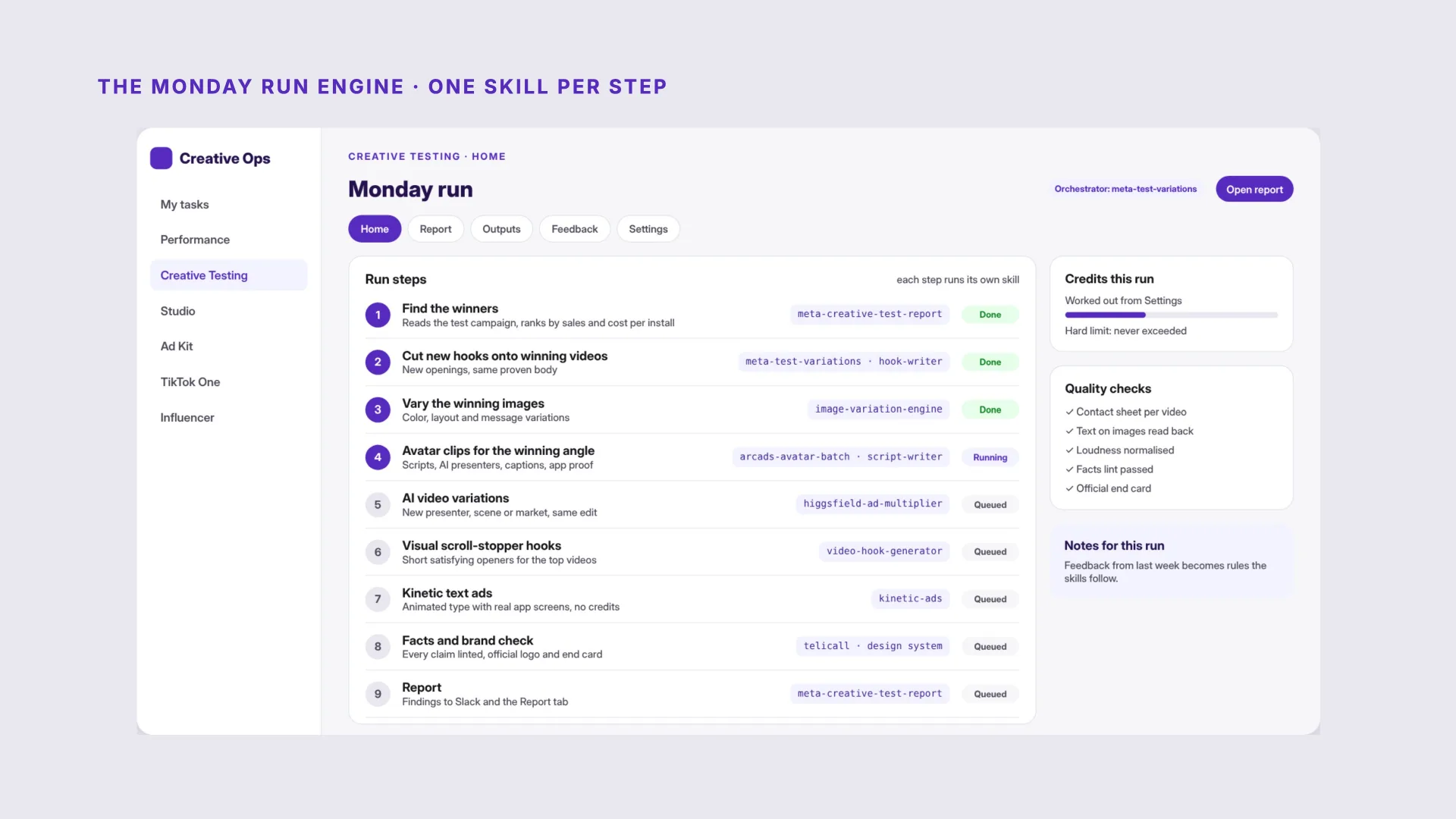
This is where “more winners” actually comes from. Winners used to stall. Now every winner automatically becomes the parent of next week’s variations.
Every note becomes a rule
AI makes mistakes. The question is whether it makes the same mistake twice.
When the machine isn’t sure about something, a question lands in my dashboard like a social feed: “Film 2 opens on a face-up phone instead of face-down. Keep it or regenerate?” I answer or leave a note. The AI fixes the output, and the note is written into the skill as a rule that every future run follows.
Some problems are now fixed for good: retyped logos and wrong fonts, prices outside the rules, kits missing pieces, films without captions. Others still need a human eye: AI faces drifting between clips, garbled text on screens, bold claims that need review. And taste, meaning the call on what to support with visuals, stays mine.
Live numbers, and a weekly read on what to do with them
The performance tab shows live results across platforms, read-only: nothing on that screen can change a campaign. More useful is the weekly diagnostic, which sorts every creative into four action lists:
- Creative fatigue: results sliding while frequency climbs. Next: new opening, same body.
- Test winners not scaled: ads that won their test but never left test budget. Next: a scale recommendation.
- Hooked, low results: strong hook and hold rates, weak conversion. Next: keep the hook, rewrite body and CTA.
- Variate: proven winners ready to iterate. Next: change one thing at a time: hook, presenter, format or language.
Every item can be sent to production in one click, with the brief already filled in.
Creators, at scale
AI-generated ads don’t replace creators. They make creator work go further. The same skills write fact-checked campaign briefs for creator marketplaces, track every incoming creator video with its hook and hold rates, and run influencer outreach from search to delivery: AI writes a personal message per creator, and it only goes out after I approve it.
AI does the work; I keep the keys
None of this works without guardrails:
- Approval before spend. Every paid generation shows its plan and cost first; budgets have hard limits.
- One source of facts. Prices and claims come from one fact sheet; a lint blocks anything else.
- Read-only on ad accounts. The dashboard reads campaigns; changes happen only in the launch layer, with approval.
- One design system. Official logo, end cards and colours; the AI never redraws the brand.
- Quality check last. Every video and image is reviewed before it’s marked done.
- Feedback that sticks. Notes become rules for the next run.
What I learned
Volume only matters if the loop closes. Making ten times more ads is easy with AI. Making ten times more ads that each teach you something is the hard part. That only works when every test feeds straight back into next week’s production.
The playbook is the product. The AI models change every few months. The skills, my own way of researching, briefing, editing and reading tests, written down, are what make the output consistent.
Guardrails create speed. Hard budget limits, one fact sheet and approval before spend sound like brakes. In practice they’re what let me hand the machine more work without checking every step.
The biggest shift isn’t speed. It’s that my job moved from making ads to deciding which ads should exist. The machine runs. I steer.
Want to see how it works, step by step? Explore the AI Creative Machine →
Want a machine like this for your team? collab@ugurucar.work