Reach Your Fans and Grow Your Business With a One-Page Marketing Plan

More than half of small businesses don’t have a marketing plan. Either they don’t know why they need one, or they don’t know how to make one.
According to a survey of small business owners in the United States:
- They don’t know how they’ll grow. 25% of respondents weren’t sure how they’d grow their business the following year.
- Their marketing budget is under 5%. 55% of small business owners spend less than 5% of their annual revenue on marketing.
- Less than 5 hours a week. 58% of small business owners spend five hours a week or less on marketing.
- Anything but marketing. 86% of respondents would rather spend time on other parts of the business than on marketing.
By the end of this post, you’ll know why you should spend more time on marketing, and you’ll be able to see your business’s growth potential by using that time well.
Why do you need a marketing plan?
A marketing plan helps you understand your audience and offer products and services that fit their needs. Making one takes time, research and commitment, but in the end you’ll have a roadmap for your business and see its growth opportunities much more clearly.
The most important thing about a marketing plan is that it puts every interaction you have with customers (and the market) on paper, so you can see the big picture.
Writing a marketing plan helps you:
- Set specific, measurable goals and timeframes for your marketing activities, so you use your time better.
- Define your target audience and understand their needs.
- Have a strategy for reaching your audience: your brand message, your story, your marketing channels and the tools you’ll use.
- Manage your brand positioning more precisely.
- Get an overview of your competitors and the market.
What does a marketing plan (normally) include?
A detailed marketing plan covers the points below in depth, and these plans are fairly long documents. That’s not what we’re doing here, but if you’re curious, here’s a quick summary:
- Executive summary: the introduction to the plan, with a summary of its aims, goals and recommendations.
- Current market situation: defines the target audience and the company’s market position, including the market, product performance, competition and distribution.
- Threats and opportunities: SWOT analyses that explain the threats and opportunities products and services may face.
- Objectives and issues: once opportunities and threats are clear, the plan sets objectives and the possible issues that could block them. Objectives are usually numerical.
- Marketing strategy: the strategy for reaching the objectives, including the marketing mix, positioning and target market.
- Action programmes: the strategy turned into actionable tactics, with who does what and when.
- Budget: once the action plan is set, a matching budget, with sales forecasts and costs like production, physical distribution and marketing.
- Controls: methods for tracking progress, with a specific timeframe for goals and budget.
Making a one-page marketing plan
Small businesses don’t need a comprehensive plan like the one above, and you may not have the time or budget for it. So you need a shorter plan. If you don’t know your business’s next move, you’re walking confidently towards failure.
The one-page marketing plan has nine questions across three stages: before, during and after the sale.
Before: prospects
1. My target market
Trying to reach everyone with your product or service never makes sense. Targeting everyone is expensive and can do more harm than good. If you describe your target market as “everyone”, you’re really saying “no one”. Widening your target market to make more money is a critical mistake, and the same rule applies in digital marketing.

Big companies can try to reach “everyone” by advertising on traditional media. That’s a long-term branding effort and not a suitable strategy for small businesses. As a small business owner, you need to narrow your audience. This is sometimes called a niche.
Let’s look at niches more closely. Say you run a beauty salon offering lots of services: massage, haircuts, colouring, brow design, waxing, manicures, pedicures and cellulite treatment. Narrow your niche. Say cellulite treatment is your niche. You can narrow it even further and focus on cellulite treatment for new mothers.
That way, a new mother who sees your ad is directly interested. If you speak more broadly, you might lose these people. So there are two critical things here:
- Targeting
- Relevance
Another example comes from photography. You might shoot lots of kinds of photos, but you’ve chosen wedding photography as your niche. Do you think a newly married woman will choose a photographer who shoots planes at airports and lorries for logistics companies and tries to cover everyone, or someone who calls themselves a wedding photographer?
The right targeting helps you get ahead. Of course, you may offer services in different areas, but each ad campaign should focus on one niche. Find your niche!
On top of that, targeting a niche audience gives you a pricing advantage too. If you need brain surgery, do you want someone whose title is “doctor”, or a brain surgeon?
If your child gets ill, a general doctor or a paediatrician? With niche targeting like this, fees can rise dramatically.
If you’re a yoga teacher, an ad for “yoga for lower back pain” is far more effective than one that just says “yoga classes”.
Other things to consider when choosing your target market:
- Personal fulfilment: you can’t do a job well if you don’t love it. The Japanese have a lovely concept for this, ikigai.
- Market value: in marketing, wants and demand are different things. Demand is a want backed by purchasing power. Is your audience ready to pay for your service? In other words, is there demand?
- Profitability: is the work you do for this segment profitable? What costs will you carry? What matters isn’t revenue, it’s profit. Some customers can cost you more than they bring in.
2. The core message I give my target audience
One aim of your message is to grab your audience’s attention, but attention alone means nothing. If it did, everything attention-grabbing would succeed. The real point of grabbing attention is to push people to take an action or respond.

There are different ways to get your message to your audience: social media, ads and personal selling. Let’s look at ads.
Ads can have different goals: building brand awareness, making sales, gaining followers, or promoting products and services. The most common mistake is making one ad for several goals. An ad should have one goal and nothing unnecessary in it. Ad space is valuable, and nothing should pull the customer’s attention away from your message.
If you advertise, you also need a roadmap for your potential customer. For example, say you’ve written an e-book and you’re promoting it. The e-book ad brings potential customers to your website and collects their emails. Then you send them emails with blog posts about the solutions your business offers.
Ads aimed directly at sales usually aren’t very effective. You need to communicate what benefit you’ll give your customer and send the right message.
Another common mistake is focusing on yourself rather than the customer. Even your “About us” page doesn’t have to be about you, it can be about your customer.
Value proposition
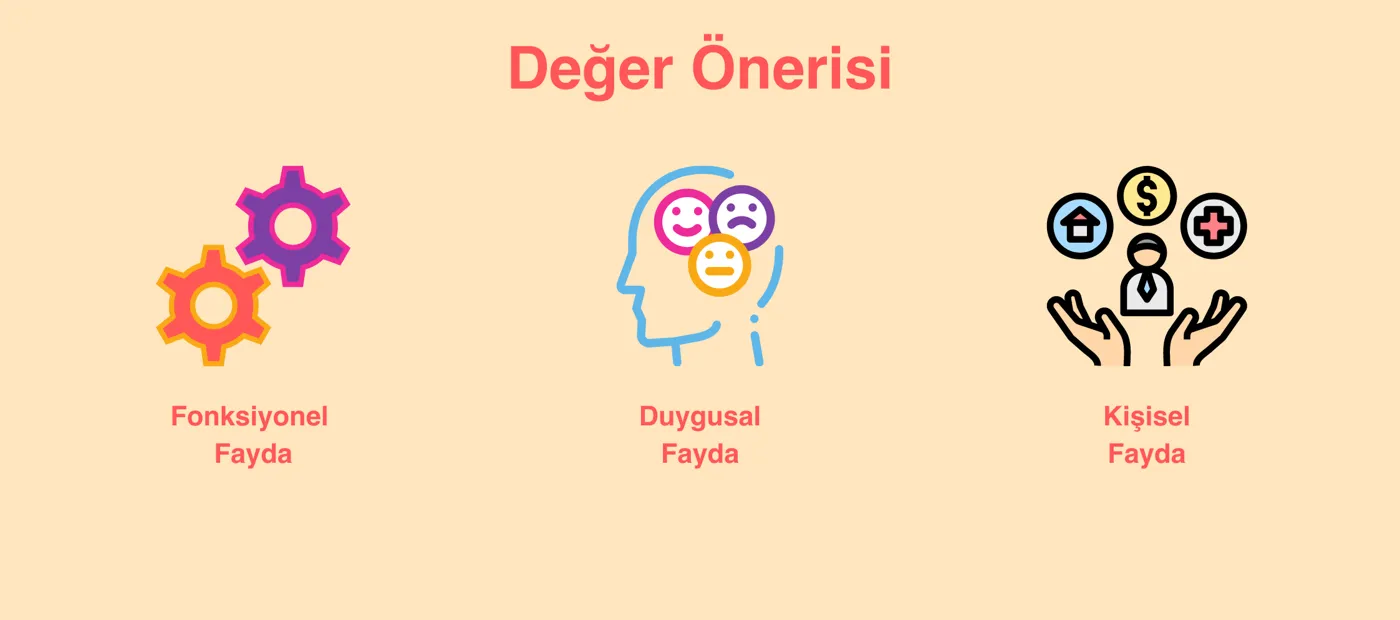
Your value proposition is proof that your business deserves to exist. If nothing is left when you delete your name, logo and website, you haven’t differentiated. Your value proposition is the unique reason customers choose you. You can price by looking at competitors and steer your marketing by them, but that makes you just another business in your sector.
The most important thing to know is that marketing has room for trial and error. If you want to stand out, you have to try new things and do what hasn’t been done before. Even the most experienced marketer will tell you that you won’t succeed on your first try.
Sometimes you need to think “illogically”, because if you think logically, what you’ll do is easy to predict and copy.
A common mistake when building a unique value proposition is a message like “quality products and service”. Quality products and service (in line with the price) are the baseline, and customers already expect them. Every business will claim its products are the best.
Another problem with “quality” messages is that customers can only experience the quality after they buy. A unique value proposition should convince them before they buy.
If you don’t have a unique value proposition, you can try to build a cost advantage. But competing on cost is very hard for a small business. If your restaurant tries to beat Burger King on cost, sadly that won’t be sustainable.
To build a unique value proposition, ask yourself two questions:
- Why should the customer buy?
- Why should the customer buy from me?
These questions need clear and unique answers, because “we’re the best” won’t convince anyone. The uniqueness doesn’t have to be in your product. In fact, very few products are completely unique and irreplaceable.
People don’t queue outside Apple stores to buy a phone. They queue to buy an iPhone.
3. The media I’ll use to reach my audience
Media is how you communicate with your audience, and it represents a big part of your marketing budget. So choose and manage it carefully.
Measuring return on investment matters in marketing. It shows you what works and what doesn’t, so you can focus on what does. In digital, this is easy. There are tools that let you track the return of ads on Google, Facebook, Instagram or LinkedIn precisely. The same can’t be said for traditional methods.
There’s also free media. In marketing we call this earned media. It costs little or nothing, and you earn it by building relationships. The best example is the followers we earn on social media.
Social media is a very popular tool that every business uses without asking whether it needs it. Remember: social media is a “medium”, not a strategy. You can build a social media strategy around your marketing strategy, but social media isn’t the top of your pyramid. If you focus everything on social media, you can miss the other stages of the customer journey.
Social media also isn’t the best place to sell. As the name says, it’s social. Imagine you’re at a party and a friend comes over and tries to sell you something. It wouldn’t make much sense. So instead of trying to sell on social media, use it to drive traffic to your website, blog or newsletter.
One more note: social media isn’t truly earned media, because the assets you build there belong to the platform, not to you. So think twice before investing in it. On Facebook, for example, you used to be able to send free updates to everyone who liked your page. Now, if you want to reach everyone who likes your page, you have to pay. Businesses that spent big budgets growing their pages took a huge hit.
Another free medium is email marketing. Email lets you communicate directly and personally with your prospects and customers. Having an email list can play a big role in your online marketing strategy. We’ll come back to this when we talk about reaching prospects again and growing your prospect base.
As an unusual channel, you can also use real post. An “I love you” handwritten in a card for your partner is definitely more touching than an email. This is the idea of costly signalling: actions that cost you more are worth more. That’s why traditional media, despite being expensive and imprecise, is still one of the biggest brands’ main choices.
During: leads
4. How I capture leads
Most people don’t buy a product directly without knowing the brand. So once your business meets a potential customer, you need to keep the relationship going for a while, which means you want their contact details. Just like dating: it was a great conversation, and you should ask for their number to get more.
A lead is a consumer who has left their contact details to receive sales and marketing offers about a brand’s products or services.
The value of leads is that they let you focus your marketing budget. Let me explain.
Say you spend 1,000 lira on ads and reach 1,000 people. Only 100 of them respond the way you want. That’s 900 lira of wasted ad spend, at 1 lira per person. What if, instead, you spent 10 lira per person on the people interested in your product and focused on turning them into loyal customers? To do that, you need leads. To get them, you can use what’s called an ethical bribe. For example, you create an e-book called “8 big mistakes wedding photographers make” and give it away free in exchange for an email address. You can offer free trials or extra benefits on the first purchase. Then you point your marketing budget at the leads you’ve collected.
5. How I nurture leads
This stage is about making people who are vaguely interested in your product actually want it. It involves outshining your competitors and giving customers a differentiated value proposition, which I covered under “the core message I give my target audience”.
To do this, you need strong marketing infrastructure. Some elements of it might be:
- Lead capture websites
- Newsletters
- Blogs
- Free reports
- Direct mail
- Email campaigns
- Social media
- Online videos
- Print ads
- Handwritten notes
- Email automation
- SMS automation
Each of these can be thought of as a marketing asset. Used well, these assets build trust between you and your customer and make the exchange of value easier. They’re not limited to the list above.
You can test which of these methods work, and how well, by running A/B tests and picking sample groups from your customers.
This work should be automated, and if it can’t be automated, it should be delegated.
Marketing calendar
It pays to create marketing calendars. That way you can keep track of the special days your customers care about and send them greetings. Your yearly plan might include activities like these:
Daily: social media posts, comments and replies
Weekly: a blog post
Monthly: an email newsletter
Quarterly: a reminder to customers who haven’t bought recently
Yearly: a gift or some kind of benefit for all customers
Once you’ve answered “what” and “when”, you need to answer “who”.
Collaboration
At school we learned to be independent. We studied every subject separately and were expected to succeed in all of them. If three friends got together to answer an exam, it was cheating. But one of the most important truths of business is collaboration. Several people with different skills work together on one goal and succeed.
A business needs three basic types of people:
The entrepreneur: someone who sees a gap in the market, takes action and can handle risk.
The specialist: the people who make your vision real, like your engineer and your designer.
The manager: the people who make sure things run smoothly.
If you run your business alone, once you’ve defined your tasks, don’t be afraid to outsource some of the work. Sadly, you can’t do everything yourself. For example, if nobody is there to follow up, there’s no point making a marketing plan, because it won’t be carried out.
6. My sales conversion strategy
In the last two sections we looked at how to find leads and how to manage them. Of course, these leads don’t mean much for your business unless you turn them into sales. At the end of the day, every business exists to make money.
Sales is a separate function from marketing, and I should say I can’t give you a complete sales education in one blog post.
Whatever you sell, you can’t sell it without good marketing. A product can only improve up to a point, after which competition comes down to how well you market yourself.
A quality product doesn’t sell itself.
To sell professionally, you need a few tools:
A professional website
If your prospects want to learn about you and your solutions, they’ll definitely look at your website. Some signs on your site can make you look bad. To look professional, your website must have:
- A phone number or clear contact details
- A privacy policy
- Quality design and UX
- An address
I recommend working with a professional for your design needs. Many business owners think they can do it themselves and end up with websites that are basically unusable. A bad, slow website also hurts your Google ranking.
A professional email address
We often see small business owners using generic Gmail or Hotmail addresses. That’s far from professional. Which of these addresses gives you more confidence?
Customer relationship management software (CRM)
A CRM system is the lifeblood of your marketing. It lets you track small details about your customers and use the automations I mentioned above effectively.
If you already have these tools, let’s look at some important sales strategy decisions.
Guarantees
Before buying from you, a customer may have some worries:
- Will you send someone inexperienced and still charge the full price?
- Will I be able to reach you when I urgently need you?
- Will the problem you solved come back, and if it does, will I get help?
- When I need an explanation, will I just get empty words?
To let customers buy from you with peace of mind, you need to remove these worries. And they only go away when you remove the risk.
Words alone aren’t enough:
- “We guarantee high-quality service!”
Give an actual guarantee:
- “If you’re not happy with our service, you get your money back.”
- “Free repairs for the first 6 months if there’s a technical fault.”
Are guarantees like these risky for you? If you’re bad at what you do, yes. But if you train your staff and consistently deliver quality, there’s no risk. I cover the product and service side of your plan in section 7.
Pricing
Pricing is one of the hardest decisions you’ll make. There are three basic pricing strategies in marketing:
- Cost-based
- Value-based
- Competition-based
Pricing directly affects how customers perceive value. So don’t sell quality service cheap.
Most businesses decide by looking at how competitors price (competition-based). A common version is pricing just below the market leader. Another popular approach is adding up costs and adding a profit margin on top (cost-based).
These models are useful and a good place to start, but pricing is also directly tied to marketing and psychology. Ignore them and you may be throwing away a lot of money.
Package options
Whatever sector you’re in, products and services come with options. But how many options to offer is an important question. Offering as many as you can might sound like a good idea, but history shows it isn’t. Too many options make it harder for customers to decide and can hurt you.
Instead, use a standard and a premium option. If you want to go further, you can use psychological tactics like the decoy effect. Here’s the famous popcorn example.
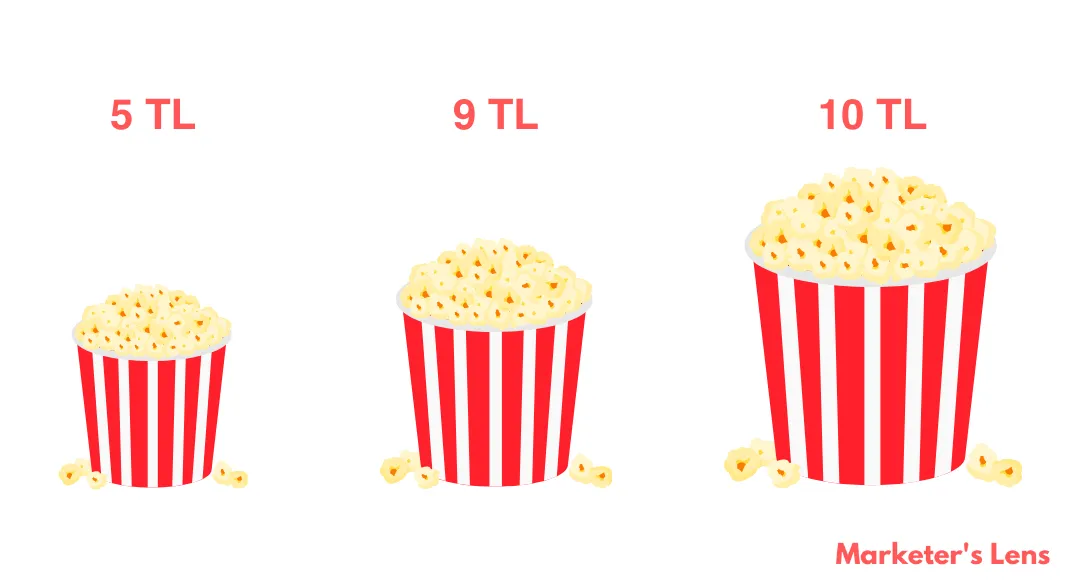
The best example of more options not meaning more profit is Apple versus other smartphone brands. Apple releases two or three phones in each series, while its competitors release many more. That makes deciding harder. iPhone users, on the other hand, know exactly what they want when they need a phone and buy with confidence.
Unlimited service
Most people fear unexpected charges. One tactic for removing that risk is offering an unlimited service guarantee:
- An IT company offering unlimited support for a fixed monthly fee
- A restaurant offering unlimited drinks
This can sound scary, because people could abuse it, right? Yet at fast-food chains with free refills, very few people drink more than one cup, even though it’s unlimited and completely free. If it might be abused, set terms of use.
Do you have a Netflix subscription? You can watch as much as you like, and yet there are weeks and months when you don’t watch anything, right?
Especially if what you sell has to be used within a certain time, unlimited use carries no risk.
When people buy something, they overestimate how much they’ll use it. Is there something at home you bought thinking you’d use it all the time, but hardly ever did? I’m sure there is.
Discounts
Discounts are nice and they boost sales, but use them carefully. They work especially well in economically struggling markets. Getting a deal gives all of our brains a hit of dopamine.
The discount mania that came with e-commerce has worn down respect for discounts. Brands happily discount through retailers, but on their own official sites you see the full price. There’s a lesson here.
A better option than discounting is increasing the value you give. In some markets it works the other way round: when the economy struggles, many brands shrink package sizes instead of raising prices. Of course, these are mostly fast-moving consumer goods.
Free trials
Offering a trial makes selling much easier and is a very effective way to introduce a product. Wouldn’t you want a test drive before buying a car?
A product may not market itself, but it can absolutely sell itself. Say you want to adopt or buy a dog from a pet shop. The staff tell you that you can try it for a few days and bring it back if there’s a problem. Instantly, all your worries about buying disappear. Without that offer, your worries would probably have stopped you, because you’d be taking on a big responsibility.
Sales prevention
- Cash only
- A fee for paying by card
- A minimum purchase amount
- Shipping charges
Please shut down your sales prevention departments. Offer things the way your customer prefers.
After: customers
7. How I deliver a world-class experience
Give your customers what they need, but sell them what they want.
Example 1: At a restaurant, the customer needs to eat, but “food” means nothing as a value proposition. What the customer wants is the feeling of being there. If your customers care more about photographing the food than eating it, change your restaurant’s design and your tableware accordingly.
Example 2: Say you’re a personal trainer. Give your client what they need: a healthy life. But a healthy life is a very long-term goal, and sadly people don’t like moving forward without seeing quick results. So promise them what they want: looking great, sexy abs or better glutes.
One of the most effective ways to make sure you deliver a world-class experience is to become a thought leader in your sector. That happens through content marketing. Useful YouTube videos and blog posts raise your visibility online and build trust with customers. When customers come to you not just to buy but for advice, things are going well. By seeking out other valuable voices in your field, like mentors, coaches and successful peers, you can lay the foundation for your own valuable ideas.
Pressure sales tactics are fading. In an age where everyone can find almost any information online, the most valuable currency is reputation. The reputation economy means turning your marketing from pressure selling into education-based marketing.
You need to position yourself as an authority in your target market. Everyone wants to hear from a credible source. As a content creator, you position yourself as an authority and expert in your niche.
Another important point is to show what you do. Tell your audience about all the effort that goes into delivering your product or service. On your packaging, share the details of how carefully you prepare or make your product. The same applies if you offer a service: tell people about your skills, how you got them and how you train your staff. What happens behind the scenes is part of your marketing. Don’t let your effort and skill go unnoticed. But don’t make this mistake in your ad campaigns: if a cute cat works better in your ad, you don’t have to show off the new machine you just bought.
If you left your business for a while and went abroad, would it be in better or worse shape when you came back? If you answered “worse”, you probably don’t have a business, you have a job: the business is you. Many small businesses make the mistake of not building systems into their work. After all, the business is small, and the founder or founders fill every role. Sadly, that thinking keeps them small and trapped in their own business.
To start building a system, follow these steps:
- Define every role in your business
- Define the work each role does
- Write a practical checklist for that work
Then see which of these processes you can automate. But be careful: software should make things smoother for the customer, not harder.
8. How I increase customer lifetime value
Raising prices
One of the most overlooked ways to increase customer lifetime value is raising prices. Most businesses fear that raising prices will cause a backlash. Of course it needs to be handled strategically, but your customers are usually much less price-sensitive than you think. Especially if you position yourself well, as discussed in section 6, and deliver a great customer experience, as discussed in the previous section, most customers will happily accept it.
To understand this, look back at your own buying habits:
- When did you last skip buying coffee at Starbucks because prices went up?
- Have you ever noticed the price of your favourite snack and put it back?
- Do you know how much you pay for your Spotify subscription?
The key to raising prices in a way that works for your customers is giving them a reason. Explain the improvements in your product’s quality or the higher input costs you’re covering. Explain the benefits they get from your offer and how they’ll benefit from your future innovations. Even with an explanation, some customers may leave, but the ones who leave will probably be your lowest-value group.
If your customers are very price-sensitive, a common approach is to keep the price fixed for existing customers and raise it for new ones. You can even market this to them and make them feel valued.
Add-ons
Another way to increase lifetime value is offering extras. “Would you like to upgrade to large fries for 2 lira more?”
This is where the contrast effect comes in. After lifting a 10 kg dumbbell, 2.5 kg feels very light. Sales work the same way. When you’re buying a 5,000 lira smartphone, an 80 lira case doesn’t seem expensive. But if you were buying the case on its own, you might compare prices, see that it’s above average and walk away.
Another benefit of the contrast effect is that customers can’t fully judge the value of the add-on, because it’s not what they came to buy, so they don’t know much about it. Many businesses make their profit on add-ons rather than the main product.
A perfect example of increasing lifetime value and profiting from add-ons is game consoles. A PlayStation is much cheaper than it should be, because the games you’ll buy from its exclusive store add up to much bigger payments over a long time.
Social proof
E-commerce sites show “customers who bought this also bought these”. By showing other people’s buying habits, you show the customer what’s “normal”.
Upgrading packages
Another way to increase lifetime value is moving existing customers to more expensive packages. Your phone company calls you once a year to tell you how a better plan will change your life. And this tactic isn’t just about more profit. By offering customers better value and talking to them about it, you can also stop them going to competitors.
As mentioned earlier, having different packages, one of them expensive, matters.
Increasing purchase frequency
Getting customers to buy from you more often is another solid strategy for increasing lifetime value.
Reminders. People live busy lives. They don’t always remember to do things on time, even when it’s good for them. Send reminders by post, email or SMS to prompt them to do business with you again. Regular reminders can be fully automated, so let technology do the hard work for you.
Subscriptions. Some products and services, like internet access, insurance or electricity, naturally fit a subscription model. But you may need to think outside the box and innovate in how products that are traditionally sold one-off are sold.
9. How I encourage word of mouth
This section isn’t called “word-of-mouth marketing”, because many businesses assume word of mouth happens automatically when they do good work. That’s far from the truth. You can create word of mouth with incentives.
The biggest part of the problem is that business owners fear looking needy or desperate by actively asking for referrals. Encouraging word of mouth feels to them like begging or asking for a favour.
Look at yourself again. When you recommend a product or service to friends, do you do it as a favour to the business owner? No, you do it because you care about your friend. That’s what we want to encourage. Rather than hoping people share us, we want to organise the process and make referrals more intentional.
A short story about this.
The other day I felt like something special, so I ordered food. When the courier handed it over, he said “I brought it to you while it’s still hot,” and as he left, he gently added, “Please leave a nice review.” It didn’t bother me. What he said became part of my restaurant experience, which started with me getting hungry and would end with me being full. Of course, that interaction stuck with me, and I didn’t forget to leave a review.
My advice to restaurants: on delivery platforms, treat every customer like a food critic, and see your couriers as your waiters.
What actually happens when we ask for a referral?
- We acknowledge them and appeal to their ego. People like being appreciated.
- We’re not asking for a favour, we’re offering something valuable they can give to someone they know.
- We give them a reason to refer us, one that benefits them directly.
What we’re really doing
- Making sure they know they’ll get a great result
- Showing them the benefit they’ll get by referring us
- Creating expectation (without being pushy) so they start thinking ahead about who they’ll recommend us to
- Handing them the power by saying it’s natural for us to do a great job for them
Who do your customers do business with before you?
It’s natural to see your customers as your customers, but remember they’re also other businesses’ customers. There may be other reasons behind how they respond to what you offer.
Let me unpack that. If you sell pet food, for example, vets might be the right place to find new customers.
Let’s take it further. Say you sell a type of food that vets recommend to their clients. You partner with a vet and give them 20 lira coupons to hand to clients they recommend that food to. This is a win-win-win.
- The vet is simply giving their clients money.
- The client gets a discount out of nowhere.
- You get new customers thanks to a recommendation from a trusted source.
What we’re doing here is working with the business your customers were customers of before you, to trigger word of mouth.
Wrapping up
We’ve gone through every step to consider when making your one-page marketing plan, briefly and clearly. Now it’s time to put it into practice.
Three last tips:
- Learn on the way. Don’t try to perfect something. Get going and do better as you learn. Money loves speed!
- Have companions. Don’t be afraid to get help. Delegate some tasks to systems or other people. If you can’t solve a problem, ask for help!
- Don’t reinvent the wheel. Many of the problems you have have already been solved by others. The tips in this post work because you work with people, and people are emotional!